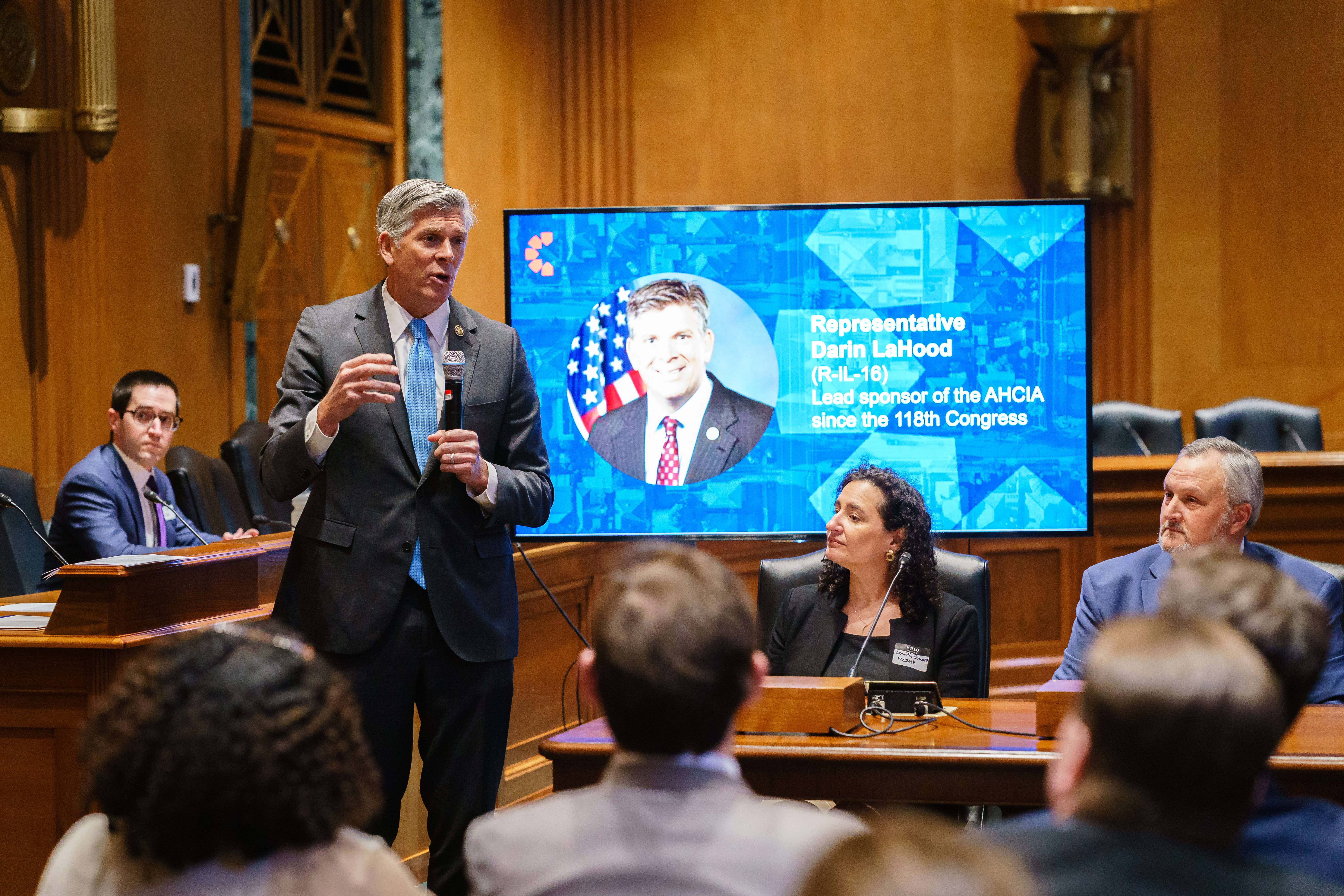

“There’s no greater time than now” to increase the power of the Low-Income Housing Tax Credit (Housing Credit), according to Rep. Darin LaHood (R-IL-16), lead sponsor of the Affordable Housing Credit Improvement Act (AHCIA). The congressman underscored the breadth of bipartisan, bicameral support for the AHCIA, which would expand and strengthen the Housing Credit. During his speech kicking off the first-ever Capitol Hill briefing organized by the ACTION Campaign, he laid out the opportunity for Congress to take action on this critical solution to address the affordable housing supply shortage in the tax reconciliation bill currently being negotiated by Congress.
ACTION Campaign Co-Chair Ayrianne Parks of Enterprise Community Partners welcomed a packed room and introduced Rep. LaHood. After his opening speech, ACTION Campaign Co-Chair Jennifer Schwartz of the National Council of State Housing Agencies (NCSHA) moderated a five-person panel of Housing Credit practitioner experts. The briefing provided a thorough explanation of the different ways that the Housing Credit provides shelter for low-income individuals and families and leads to the economic and social mobility of entire communities.
Cathe Dykstra, President and CEO of Family Scholar House, a housing and service provider for single parents pursuing post-secondary education and young adults exiting the foster care system, spoke about the power of the Housing Credit to create a foundation for economic mobility and improve children’s academic success by providing safe and secure housing. Using data which can be viewed on our website, Dykstra showed that children in stable and secure housing financed by the Housing Credit not only had higher scores in reading and math across all grades 3-12, but also had increased levels of food security, health, economic mobility, and workforce participation.
John Wiechmann, President and CEO of Midwest Housing Equity Group (MHEG), talked about the Housing Credit’s ability to bring investment to small, rural areas: over half of MHEG’s 800 properties are in towns of 50,000 or fewer people. He also emphasized the public-private partnership aspect of the Housing Credit and that Housing Credits cannot be claimed until the property is built and occupied by qualified residents.
Jennifer Seamons from Capital One explained how the Housing Credit encourages private investment in affordable housing and emphasized that the industry’s commitment to the Housing Credit is about positive resident outcomes, not “bricks and sticks.” She also stressed the fundamental importance of providing wraparound services where necessary to improve and stabilize the lives of residents who need them. Seamons emphasized that the combination of affordable housing and services is essential to achieving better resident outcomes and drives economic success individually and in the community.
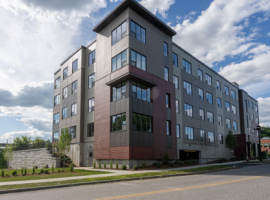
Tim Henkel, CEO and Principal of Pennrose, spoke about the breadth of the shapes and sizes, locations, and types of affordable housing that the Housing Credit finances. He emphasized that the Housing Credit is responsible for affordable homes in rural areas, suburbs, and big cities alike. The program has financed affordable rental homes in single-family subdivisions as well as apartment buildings. The Housing Credit can finance the construction of new homes, rehabilitation of older affordable properties, and also the renovation and rehabilitation (and sometimes repurposing) of older, historic buildings.
Scott Farmer, Executive Director of the North Carolina Housing Finance Agency (NCHFA), explained how state Housing Credit allocating agencies like his act as responsible stewards of federal resources, partnering with the federal government to ensure program oversight and strategic investments in the places and populations most in need in each state. He also noted that picking a favorite Housing Credit property in North Carolina would be like a parent picking a favorite child, but that each completed property really means more affordable and workforce housing for North Carolinians.
After the testimonies, a brief video testimonial from a Housing Credit resident was played. The resident reminded the audience that affordable rental housing helps solve the homelessness crisis and can help people get out of abusive and unhealthy living situations.
The event concluded with a reception, in which NCSHA Executive Director Stockton Williams, Enterprise President & CEO Shaun Donovan, Rep. Jimmy Panetta (D-CA-19), and Sen. Maria Cantwell (D-WA) – who has been the lead Senate sponsor of the AHCIA since it was first introduced in 2015 – all spoke about why expanding production for affordable rental housing is more important than ever and shared stories about the Housing Credit’s impact.


With the imminent reintroduction of the AHCIA in Congress and the push for a reconciliation tax bill before Memorial Day, the Super Bowl of tax – or, as Rep. LaHood called it, the “Armageddon of tax” – is a once-in-a-decade opportunity to enact major Housing Credit provisions. The reception provided an important opportunity for advocates to both make the case to a bipartisan group of Congressional staffers about this urgent need and strategize with each other about continuing the push for housing affordability.
ACTION sincerely thanks the sponsors of the event who made this great event a reality.
2025 ACTION Congressional Briefing and Reception Sponsors
View information from the briefing, including speaker bios, presentations, and photos!